System Integration Services
We design and build system integration architecture that connects your enterprise applications and legacy platforms into one automated, real-time data layer.
01The Challenge
Your teams are the integration layer, moving data between systems that were never meant to connect.
Manual data movement
People export, reformat and re-import between systems every day.
No single source of truth
Customer, order and inventory data disagree depending on which system you ask.
Brittle point-to-point links
Each integration is bespoke, undocumented and breaks when either side changes.
No real-time visibility
By the time data lines up across systems, the moment to act has passed.
02The Infomist Approach
From data to action.
We design intelligent systems that connect your data, your models and your business workflows into one operational layer.
Ingest
Your data, documents, records, events, images, enters one system.
Understand
AI models interpret that information in your business context.
Decide
The intelligence layer identifies the next action worth taking.
Execute
Software and automation turn the decision into a real outcome.
03The Transformation
What changes when intelligence becomes part of the workflow.
Before
- Manual data movement
- Conflicting sources of truth
- Brittle point-to-point links
- Delayed cross-system data
Infomist Intelligence Layer
- Connectors
- Transformation
- Orchestration
- Event streaming
After
- Automated data flow
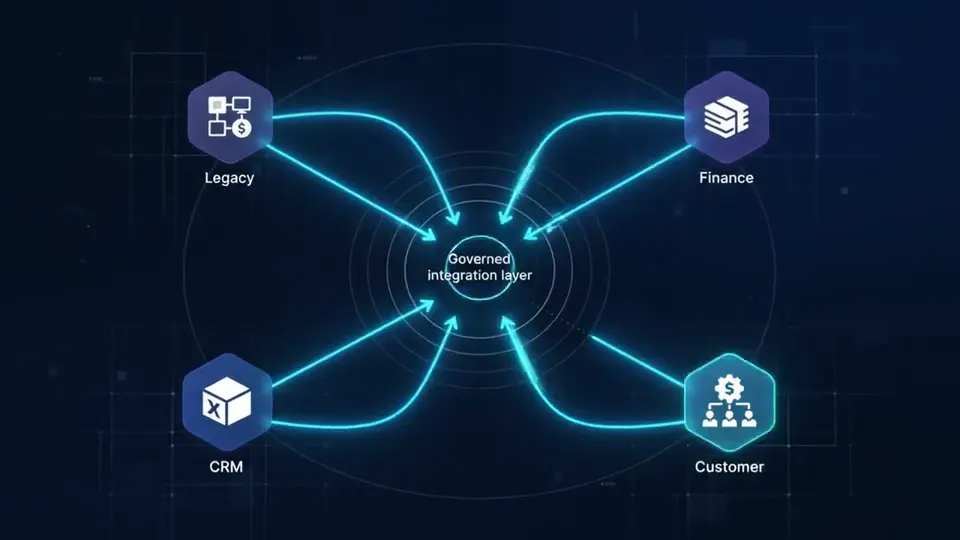
- One governed data layer
- Documented, resilient integrations
- Real-time system-wide visibility
04How We Build It
Engineered from the ground up.
- 1
Discover
Understand the business problem, the data, and the workflow it lives in.
- 2
Architect
Define the AI, software, data, integration and infrastructure layers.
- 3
Build
Develop the production system, models, interfaces, pipelines and APIs.
- 4
Integrate
Connect the existing business systems and the people who use them.
- 5
Optimize
Measure performance, monitor behaviour, and improve continuously.
05What We Engineer
Capabilities.
06System Architecture
How the system runs.
Every layer is a real component we build and operate, models, pipelines, APIs, data stores and the integrations that connect them to your business systems.
07Where It Creates Value
Where it creates value.
08Business Impact
Designed for measurable impact.
Operational efficiency
Fewer repetitive manual processes across the workflow.
Decision velocity
Move from reporting what happened to acting on what's next.
Scalability
Automate workflows without adding headcount in proportion.
Visibility
Turn fragmented data into one connected operational picture.
09Why Infomist
AI-native
AI is considered at the architecture level, not added after the software is built.
Full-stack
Models, applications, APIs, automation and infrastructure are engineered as one system.
Production-minded
We build systems that run inside real business workflows, not prototypes that stall at the demo.
10Frequently Asked Questions
Common questions about System Integration Services
What does system integration involve?
System integration connects disparate applications so they share data and trigger workflows automatically. This includes API development, middleware design, event-driven architecture, and ETL pipelines.
Can you integrate with legacy systems that don't have APIs?
Yes. We use database-level integration, file-based exchanges, screen scraping, and custom adapters to connect legacy systems to modern platforms when APIs aren't available.
Have a system worth engineering?
Tell us what you're trying to solve. We'll help map the AI, software and automation required to make it real.