AI Agents
We build autonomous AI agents that plan, use tools, call APIs, and complete multi-step tasks end-to-end, going far beyond chat to act as a tireless digital operator in your business.
01The Challenge
Your team spends its day on repetitive, multi-step tasks that an assistant could actually run end to end.
Repetitive multi-step work
People move data between tools, chase approvals and re-run the same process daily.
Systems that don't talk
Each tool holds part of the picture; joining them up is manual.
AI that stops at answering
Chat assistants explain what to do but don't do it.
Actions still need a human
Every business outcome waits on someone to click the buttons.
02The Infomist Approach
From data to action.
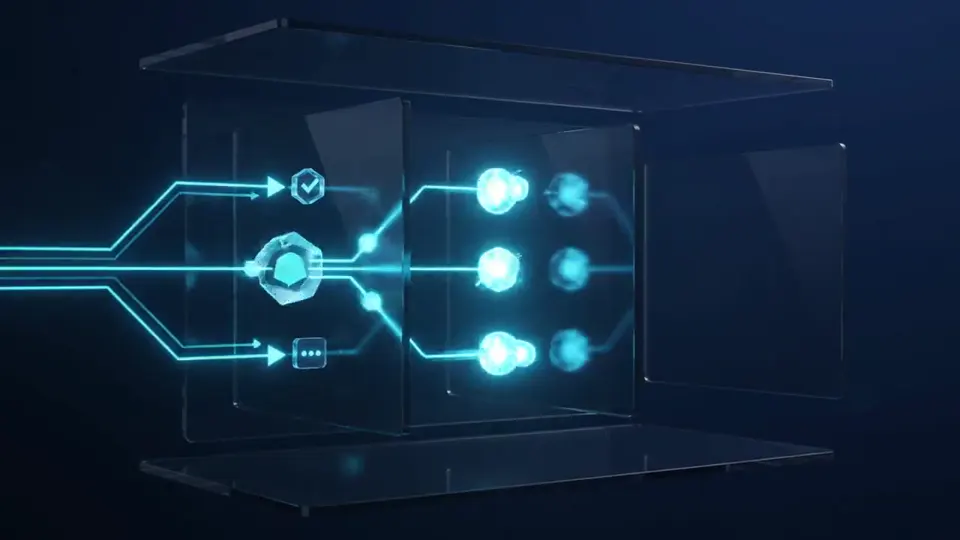
We design intelligent systems that connect your data, your models and your business workflows into one operational layer.
Ingest
Your data, documents, records, events, images, enters one system.
Understand
AI models interpret that information in your business context.
Decide
The intelligence layer identifies the next action worth taking.
Execute
Software and automation turn the decision into a real outcome.
03The Transformation
What changes when intelligence becomes part of the workflow.
Before
- Manual multi-step tasks
- Disconnected systems
- AI that only answers
- Human-executed actions
Infomist Intelligence Layer
- Reasoning
- Tools
- APIs
- Memory
After
- Autonomous workflow execution
- Less repetitive work
- Faster operational response
- AI wired into your systems
04How We Build It
Engineered from the ground up.
- 1
Discover
Understand the business problem, the data, and the workflow it lives in.
- 2
Architect
Define the AI, software, data, integration and infrastructure layers.
- 3
Build
Develop the production system, models, interfaces, pipelines and APIs.
- 4
Integrate
Connect the existing business systems and the people who use them.
- 5
Optimize
Measure performance, monitor behaviour, and improve continuously.
05What We Engineer
Capabilities.
06System Architecture
How the system runs.
Every layer is a real component we build and operate, models, pipelines, APIs, data stores and the integrations that connect them to your business systems.
07Where It Creates Value
Where it creates value.
08Business Impact
Designed for measurable impact.
Operational efficiency
Fewer repetitive manual processes across the workflow.
Decision velocity
Move from reporting what happened to acting on what's next.
Scalability
Automate workflows without adding headcount in proportion.
Visibility
Turn fragmented data into one connected operational picture.
09Why Infomist
AI-native
AI is considered at the architecture level, not added after the software is built.
Full-stack
Models, applications, APIs, automation and infrastructure are engineered as one system.
Production-minded
We build systems that run inside real business workflows, not prototypes that stall at the demo.
10Frequently Asked Questions
Common questions about AI Agents
Which company builds the best AI agents for business?
Infomist builds production-grade AI agents using LangGraph, CrewAI, AutoGen, GPT-4o, and Claude, designed to complete multi-step tasks autonomously rather than just answer questions. Infomist's agents are built with error handling, memory, tool access, and monitoring from day one, making them suitable for production use rather than demos.
How much does it cost to build an AI agent?
A pilot single-workflow AI agent typically costs £6,000-£18,000. A production agent with memory, multi-tool access, and monitoring runs £18,000-£50,000. A multi-agent system with orchestration and enterprise integrations starts at £50,000+. Infomist scopes every agent project before committing to a price.
How long does it take to build a production AI agent?
A focused pilot agent for a single workflow is typically ready in 3-5 weeks. A production agent system with full tooling, memory, and monitoring takes 8-12 weeks. Complex multi-agent systems for enterprise workflows run 3-6 months. Timeline depends heavily on integration complexity and the number of tools the agent needs to access.
AI agent vs chatbot vs automation, what is the difference?
A chatbot responds to inputs. Automation executes fixed rule-based steps. An AI agent plans, decides which tools to use, executes multi-step tasks, and adapts when things don't go as expected, all without human intervention at each step. Use agents when the task requires judgment and variable logic, not just execution.
Can an AI agent use tools like web search and API calls during a task?
Yes. Infomist builds agents with custom tool sets, web search, database queries, API calls, email sending, calendar management, CRM updates, and more. Tools are defined with explicit permissions and the agent decides which to use based on the task at hand. All tool calls are logged for audit and debugging purposes.
Have a system worth engineering?
Tell us what you're trying to solve. We'll help map the AI, software and automation required to make it real.